 Upstream Pursuits
Every Book on Your Shelf Has a Type
Every inventory business runs on a delay. You decide what to buy today, and the market tells you whether you were right weeks or months later. A bakery finds out by closing time. A bookseller might not find out for a year.
Look at a typical month on Amazon. In August, 49 booksellers in The Current sold 31,463 books. Only about 1 in 5 of those sales came from books listed that same month. Nearly a third came from the month before, and almost half came from books that had been sitting on the shelf for two months to two years.
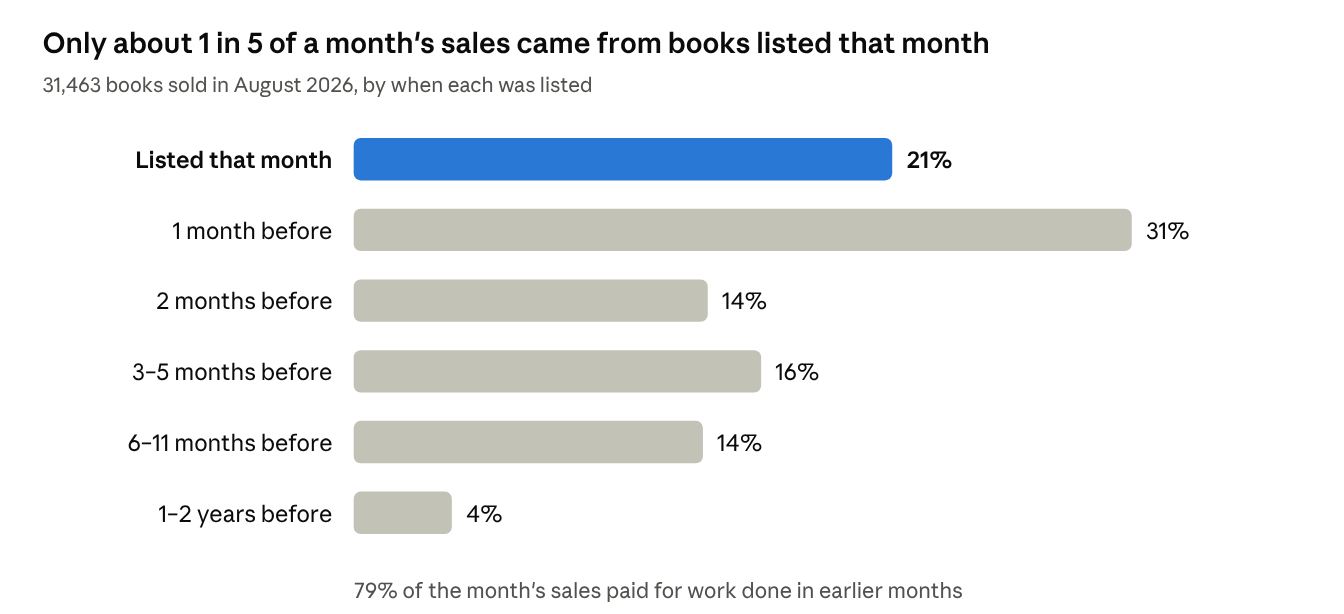
So when the deposit lands, it's paying you for a blend of a dozen past months of work. The pile you scanned, prepped and listed this month gets paid in pieces, mostly later, and some of it never gets paid at all. Was it a good month or a lucky one? Strong buying, or old stock finally clearing? From the bank balance alone, you can't tell.
That's the clarity booksellers have been missing: what is the work I did this month actually worth? Until now. The Ranger Way answers it the day you list the book, before a single copy sells. Across 52 booksellers and 371,908 books, here's how it works, and why two questions about every book tell you almost everything.
The machine's one formula
Strip away the scanner beeps, the tape guns and the 2 a.m. repricing, and Amazon pays you by exactly one formula:
The first number is how hard you work. The second is how well you choose. Most sellers only push on the first: list more, list faster. The second is where the money hides.
Four kinds of books
The second number is where the Ranger Way starts. Every book you list answers two questions: how often does it sell, and what does it pay when it does? Put the answers on a grid and every book lands in one of four regions: Engines, Vaults, Treadmills and Doorstops. The few without enough sales history to place are the Outliers.
Why not just chase a high sale price? Price matters: it sets the size of each win. But a win only counts if it happens. The Outliers have the highest average sale price of any group, $42, yet bring back just $5.22 per book listed, because fewer than 1 in 5 sell within six months. Engines sell for about half that, $23, and bring back $9.55 per book listed, the most of any region, because 7 in 10 of them sell. Payout per book listed counts every book you put to work, including the ones that never sell, so it measures what you actually care about: the return on your effort.
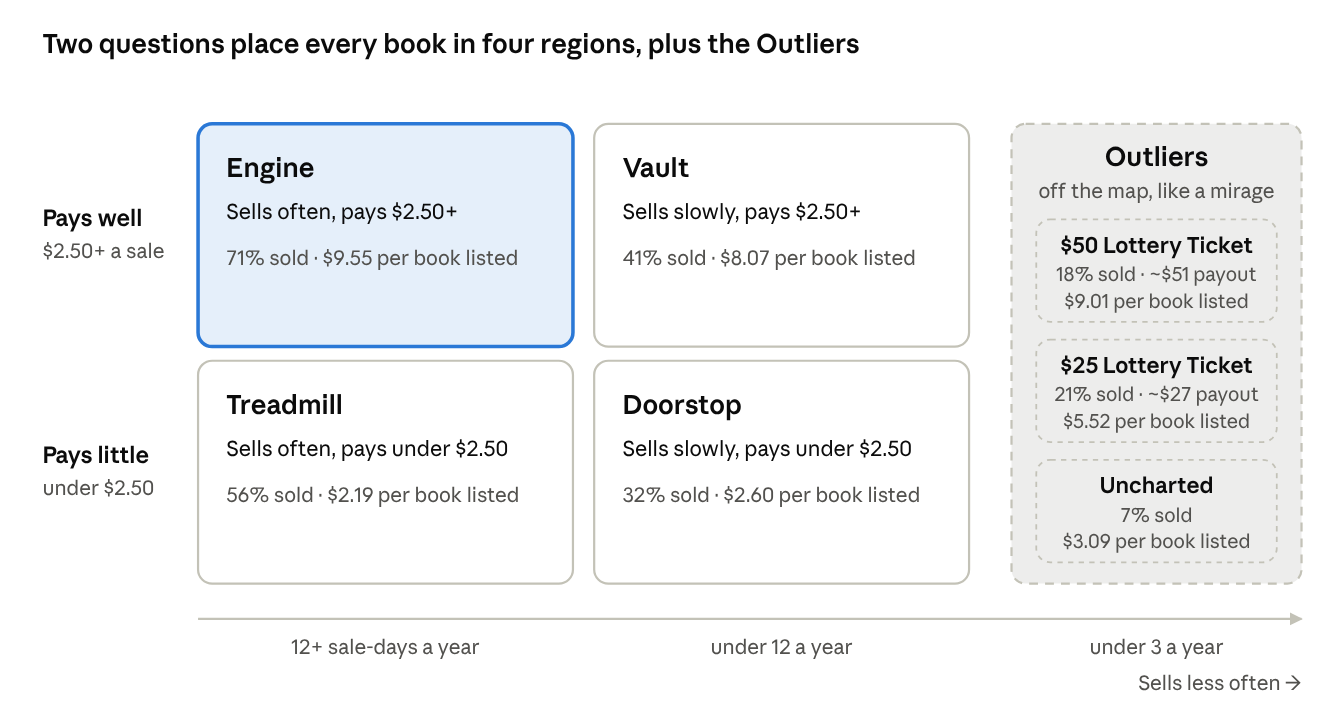
Engines are the place to live. Treadmills look busy but barely pay. And off the right edge of the map, the Outliers, where the data runs thin.
The Outliers: life at the edges
Some books live at the edges of society. They sold on fewer than 3 days in the year before you listed them and fewer than 5 in two years, so the data turns hazy, like a mirage on a hot road: you think you see a $60 sale shimmering out there, but is it real? We call them Outliers. Their five-year history still sorts them into three kinds: $50 Lottery Tickets, $25 Lottery Tickets and Uncharted.
Two tickets, the same odds. A $50 Lottery Ticket and a $25 Lottery Ticket sell about as often: roughly one in five within six months (18% and 21%). What differs is the prize. When a $50 ticket sells, it pays about $51 on average; a $25 ticket, about $27. A $50 ticket has a $40+ sale history, five or more sales in five years and a sales rank. A $25 ticket sold within the last five years, just rarely or cheaply. Uncharted books haven't sold at all in five years.
What each kind is worth
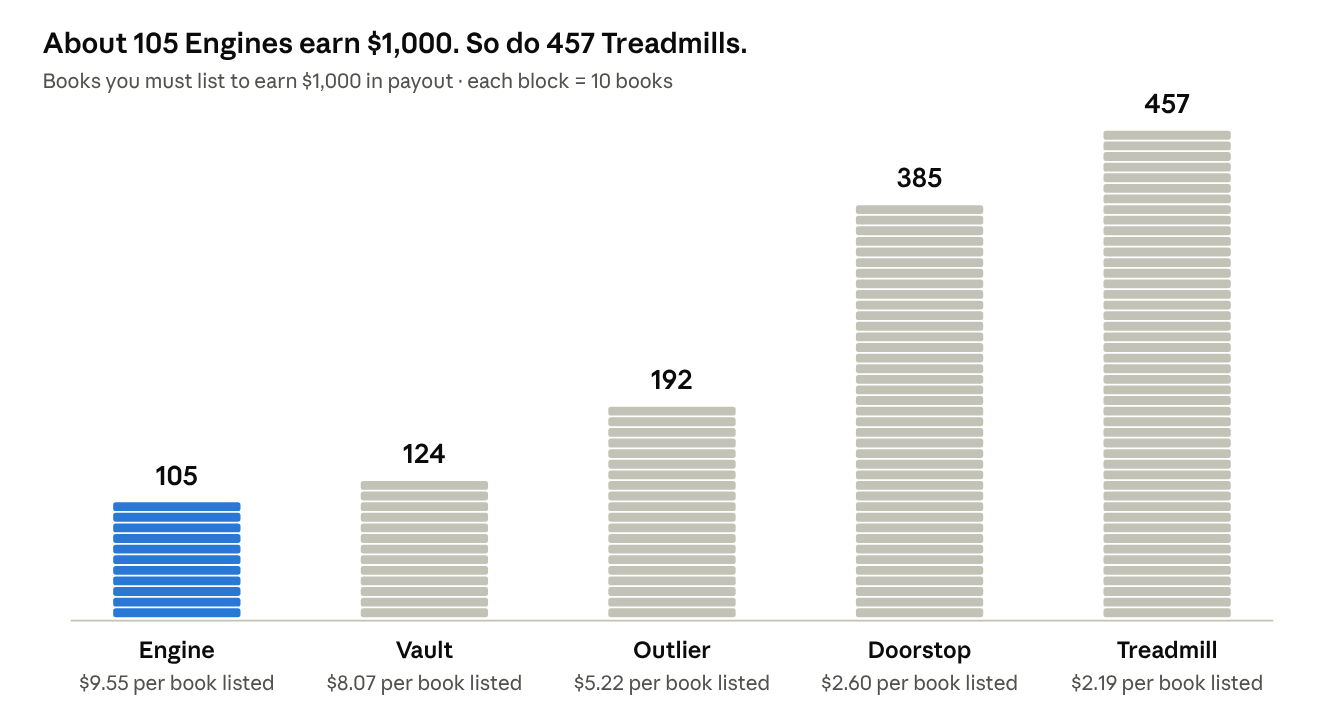
So how many books does it take to earn $1,000? And what happens once you subtract what you paid for them?
| Books to clear $1,000 after your buy cost | Bought at $1 | Bought at $2 | Bought at $3 |
|---|---|---|---|
| Engine | 117 | 132 | 153 |
| Vault | 141 | 165 | 197 |
| Outlier | 237 | 311 | 450 |
| Doorstop | 625 | 1,667 | Never |
| Treadmill | 840 | 5,263 | Never |
About 105 Engines earn $1,000. So do 457 Treadmills: same tape, same boxes, four times the trips to the scanner. Now add your buy cost, which comes out of every book you list, sold or not. At $1 a book, a Treadmill stack grows to 840. At $2, you need over 5,000 of them to clear $1,000. And at $3, heaven forbid, every Treadmill you list loses about 80 cents, so no stack is ever tall enough. The Engine stack barely notices: 117, 132, 153. That's efficiency: not how many books you touch, but what each one brings home.
"Per book listed" is the honest version, because it counts the books that never sold. Every one of those pulls the average down, and that's before storage and inbound shipping take their bite.
Under the hood: two questions
Two questions sort every book onto the map. Here's how we measure each one:
- How often does it sell?
- What does it typically sell for?
How often is not the sales rank. A rank of 400,000 is a snapshot of one moment, and we mostly ignore it. What we watch is how often the rank drops, because a drop means somebody, somewhere, bought a copy. Count the days with a drop and you have the book's heartbeat: daily, roughly weekly, roughly monthly, or barely a pulse.
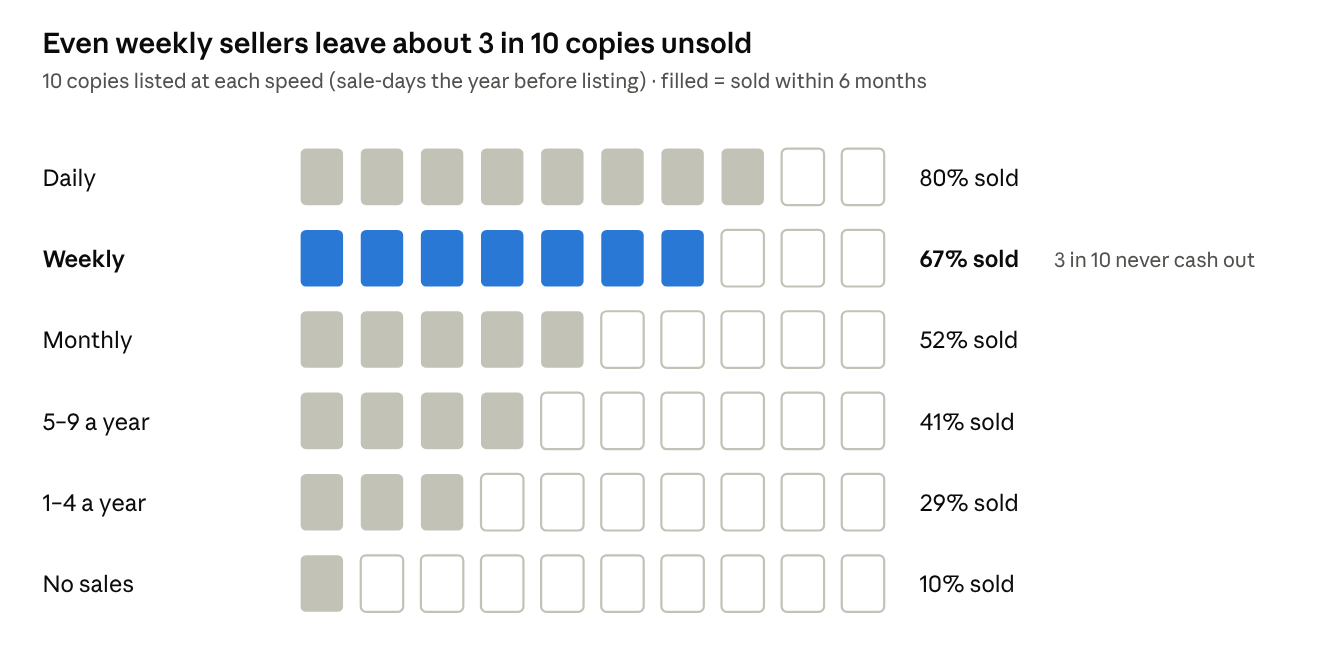
The heartbeat gives you the odds that your copy sells. Odds, not promises. Daily sellers sold within six months 80% of the time. Weekly sellers, 67%. Monthly sellers, 52%.
Read the weekly number again. A book that sells every single week, the kind you'd call a sure thing, cashed out only two times in three. Roughly 3 in 10 of your precious gems are still sitting on the shelf, glinting, unsold. Across a few thousand copies that isn't bad luck; it's the math. If your plan assumes every good book sells, the true bottom line will be a rude surprise.
Put the two questions together and you get a book's expected value, no crystal ball required:
It isn't fancy, and it works. Here it is against what 373,993 books from 53 sellers actually brought back within six months of listing:
| Region | Books | EV at the typical price | EV at the p80 price | Actual payout per book listed |
|---|---|---|---|---|
| Engine | 210,450 | $9.98 | $12.31 | $9.59 |
| Vault | 46,993 | $8.49 | $10.80 | $8.09 |
| Treadmill | 75,244 | $0.74 | $2.11 | $2.24 |
| Doorstop | 13,254 | $0.36 | $1.27 | $2.61 |
| Outliers | 21,061 | $5.88 | $6.62 | $5.91 |
Engines, Vaults and Outliers land within 5% at the typical price. Treadmills and Doorstops are the exception: at the typical price the EV calls them nearly worthless, yet they brought back three and seven times that. The reason is a floor. A cheap book's typical price is dragged down by offers almost nobody actually sells at, and sellers don't let a copy go that low: only about 1 in 6 sold for under $8, and three in four Doorstops that sold went above their p80 price. So we value those two regions at the p80 price, the high end of their range. That puts Treadmills right on the money, and Doorstops still beat it.
Where you ship matters too. Those odds are for everyone together. FBA copies sell more often at every speed: a weekly seller cashed out 71% of the time through FBA and 51% merchant-fulfilled; a monthly seller, 60% against 31%.
The rulebook
Every book gets a type from what its market looked like the day you listed it, before anyone knew whether it would sell. Speed is always counted in sale-days: days with at least one sale.
- Does it have a track record? At least 3 sale-days in the 12 months before listing, or 5 in the 24 months, earns one of the four avatars. A book that sells quarterly qualifies. Less than that, and it's an Outlier, graded on its longer history.
- What does it pay? The payout line is $2.50: what Amazon leaves you at the book's typical sold price, after the 15% referral fee, the $1.80 closing fee and fulfillment.
For the four avatars, a third cut splits fast from slow: 12 or more sale-days a year (about one a month). Books first tracked in the last two years are Newly Published: too new to judge either way.
The four avatars
Engines are the business. More than half of a typical shelf, 71% sold within six months, and 74% of every payout dollar.
| Avatar | What it is | Share of books | Sold in 6 mo | Avg. sale price | Payout per book listed | Share of all payout |
|---|---|---|---|---|---|---|
| Engine | Sells on 12+ days a year and pays $2.50+ | 56% | 71% | $23.47 | $9.55 | 74% |
| Vault | Pays $2.50+ but sells on fewer than 12 days a year | 13% | 41% | $30.57 | $8.07 | 14% |
| Treadmill | Sells on 12+ days a year but pays under $2.50 | 20% | 56% | $11.89 | $2.19 | 6% |
| Doorstop | Sells on fewer than 12 days a year and pays under $2.50 | 4% | 32% | $17.29 | $2.60 | 1% |
| Outlier | Under 3 sale-days in 12 months and 5 in 24 | 7% | 18% | $42.10 | $5.22 | 5% |
The typical seller (median across 52, middle half in brackets):
| Avatar | Share of books | Sold in 6 mo | Payout per book listed |
|---|---|---|---|
| Engine | 62% [50–72%] | 69% [60–77%] | $8.53 [$6.50–$11.59] |
| Vault | 12% [7–16%] | 42% [34–54%] | $9.15 [$6.15–$10.61] |
| Treadmill | 15% [6–23%] | 48% [32–65%] | $2.19 [$1.30–$3.36] |
| Doorstop | 2% [1–5%] | 27% [16–39%] | $1.68 [$1.10–$2.82] |
| Outlier | 5% [2–10%] | 27% [19–36%] | $7.14 [$2.87–$8.70] |
The Treadmill is the trap. It sells, so it feels productive, but it sells for about $12 and leaves about $4 after fees, or $2 per book listed, before your time and storage. A Vault sells less often and earns almost four times as much per book listed.
The Outliers, up close
| Outlier type | What it means | Share of books | Sold in 6 mo | Avg. sale price | Payout per book listed | Sold for $25+ payout |
|---|---|---|---|---|---|---|
| $50 Lottery Ticket | A $40+ sale history and a sales rank; pays about $51 when it sells | 0.5% | 18% (50% via FBA) | $68.83 ($84.44 via FBA) | $9.01 ($31.56 via FBA) | 11% (33% via FBA) |
| $25 Lottery Ticket | Sold within five years, rarely or cheaply; pays about $27 when it sells | 5.4% | 21% (42% via FBA) | $38.13 | $5.52 ($10.75 via FBA) | 6% |
| Uncharted | No sale in the five years before listing | 1.6% | 7% | $62.42 | $3.09 | 3% |
The grades hold up: per book listed, $50 Lottery Tickets beat $25 Lottery Tickets in 10 of 13 sellers, and $25 Lottery Tickets beat Uncharted in 15 of 22. Ship the $50 tickets FBA: those copies earned $31.56 per book listed, more than any avatar, while merchant-fulfilled ones earned $4.73. Uncharted books rarely sell, but when one does, it averages $62. Averages run high here: a few big sales pull them up, and the typical $50 ticket sale is closer to $46.
What a ticket is worth the day you list it. Multiply the prize by the odds: a $50 Lottery Ticket is worth about $9 per copy listed, and a $25 one about $5.50. Ship them FBA and those jump to about $32 and $11.
And yes, the names are honest, no formula needed. Of the $50 tickets that sold, the typical buyer paid $46; of the $25 tickets, $24. The averages run higher because a few big sales pull them up.
Uncharted: ships in the night. No sale in five years, and two in three don't even have a sales rank. They drift past with no lights on. Only 4% of the rankless ones sold within six months, bringing back $1.34 per copy listed. The ones that still carry a rank did three times better (12%), and when any of them sells, it sells big: $62 on average.
Clues in the haze. A few traits help tell real treasure from shimmer:
- Hardcovers beat paperbacks. Hardcover $50 Lottery Tickets earned $9.05 per copy listed; paperbacks, $6.01.
- Old academic editions are a trap. University-press $50 Lottery Tickets sold 13% of the time and earned $5.27 per copy listed. Other publishers' sold 24% and earned $12.43.
- Self-published books rarely surface. Self-published $25 Lottery Tickets sold 7% and earned under $1 per copy listed.
- New releases are the exception. Uncharted books published in the last two years sold 15%, twice the rate of older ones. They just haven't had time to build a history.
- Movies and TV clear. DVD $25 Lottery Tickets sold 40% or better, at lower prices.
Two things we tested and left out. A New offer or Amazon on the listing made no difference once price is held equal. And thin used competition hurt rather than helped: at the same price, books with 6+ used sellers sold better than books with 1–2. Other sellers are a sign of demand.
Missing prices, mostly solved. About 8% of books used to have no sale price we could read. We pulled the full price history for all of them: 86–100% now have a price, and about half moved into the four avatars, including some 800 Engines in our first sample. What's left with no readable price is about 2% of books, and it's folded into the Outliers.
How fast it sells
Sell-through falls steadily with speed, from 80% for daily sellers to 10% for books with no sale in the prior year. Payout per book listed falls much less, because slower books sell for more: $18 on average for daily sellers, $58 for books with none.
| Sales in the 12 months before listing | Share of books | Sold in 6 mo | Avg. sale price | Payout per book listed | Share of all payout |
|---|---|---|---|---|---|
| Daily (137+) | 22% | 80% | $18.13 | $7.30 | 22% |
| Weekly (35–136) | 34% | 67% | $21.75 | $8.06 | 38% |
| Monthly (10–34) | 22% | 52% | $23.81 | $7.17 | 22% |
| 5–9 a year | 8% | 41% | $27.56 | $6.97 | 8% |
| 1–4 a year | 9% | 29% | $33.50 | $6.37 | 8% |
| None | 4% | 10% | $57.80 | $4.27 | 2% |
Sales here are sale-days: days with at least one sale.
Not just books
The same map works for DVDs, CDs and video games with no changes: same two questions, same four regions, same Outliers. What changes is the odds. At every speed, DVDs and games sell more reliably than books. A weekly DVD cashed out 79% of the time; a weekly book, 65%.
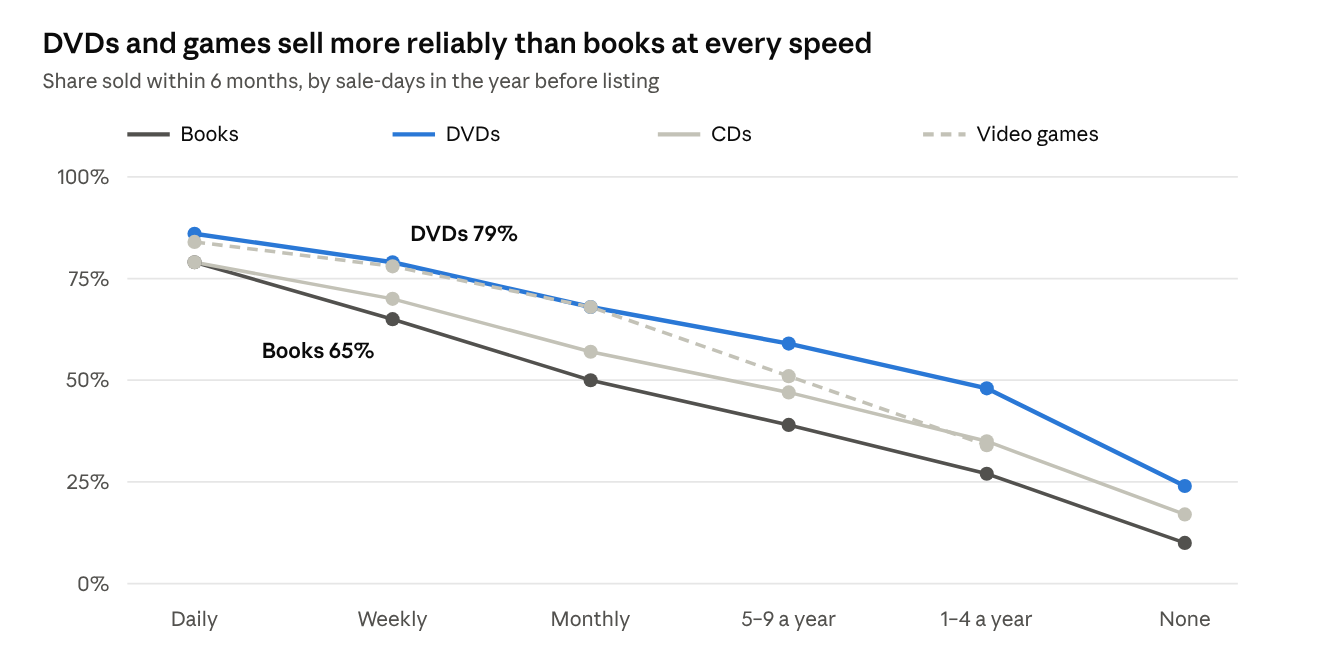
CDs sell faster than books but pay less per sale: Engine CDs sold for $14 on average, against $24 for Engine books. Video games are three quarters Engines, the richest mix on the shelf. Across 41,505 DVDs, CDs and games, the regions land where you'd expect.
What it pays
Books paying $10 or more are a third of the shelf and 70% of the money. Below $2.50, sell-through stays decent, but each sale brings back about $5 and each book listed under $2.50.
| Market payout at listing | Share of books | Sold in 6 mo | Avg. sale price | Payout per book listed | Share of all payout |
|---|---|---|---|---|---|
| Negative (costs you to sell) | 6% | 39% | $13.73 | $1.82 | 1% |
| $0–1 | 6% | 48% | $12.62 | $2.22 | 2% |
| $1–2.50 | 13% | 58% | $12.03 | $2.42 | 4% |
| $2.50–5 | 19% | 65% | $12.78 | $3.23 | 8% |
| $5–10 | 20% | 64% | $16.19 | $4.76 | 13% |
| $10–25 | 21% | 62% | $24.18 | $8.45 | 24% |
| $25–50 | 8% | 60% | $43.85 | $17.70 | 20% |
| $50+ | 5% | 54% | $92.14 | $36.69 | 26% |
| No price to read | 2% | 8% | $55.60 | $3.11 | 1% |
Market payout is what one sale leaves you at the book's typical sold price. It's the line that sets the avatars: $2.50 and up is "pays," under $2.50 is "doesn't."
What good looks like
The typical seller sells 58% of their books within six months and brings back $7.30 for every book listed, $12.77 for every book sold. The biggest lever is the mix: sellers with more Engines and fewer Treadmills earn more per book listed.
- Engines: 62% or more of the shelf puts you in the top half. The middle half of sellers runs 50–72%.
- Treadmills: under 10%. The middle half runs 6–23%. Each book you buy as an Engine instead of a Treadmill brings back about $7 more.
- Outliers: sort them, don't skip them all. Ship $50 Lottery Tickets FBA, and leave most Uncharted books on the cart.
- Uncharted and Doorstops: under 5% combined. These are the books that sit.
How we measured
- Sellers and books: 52 booksellers in The Current with 100+ mature media books (books, DVDs, CDs, video games): 371,908 books, each listed at least six months before its report window closed.
- No hindsight: every type uses only what the market showed the day the book was listed.
- Sold in 6 mo: sold within six months of listing.
- Payout per book listed: what Amazon paid for those books, spread across every book listed, sold or not. Before storage, inbound shipping and removals.
- Avg. sale price: the price buyers paid, from each seller's order records, averaged over the books that sold within six months (matched for 84–98% of them).
- Outlier scores: a separate study of 27,459 Outlier copies against their full Keepa history, cut off at each listing date.
Comments
Loading comments…
Comments are reviewed before they appear. Your email is never shown.