 Upstream Pursuits
State of the Book Market || Q1 2026
|
[Market Intelligence for Strategic Booksellers] Welcome to the very first edition of Upstream Intel: a quarterly report that dives deep into Amazon bookseller data. Market Recap:The bookselling landscape shifted dramatically in the past few months - here's what you need to know. After years of FBA dominance, the playing field just leveled out. Amazon's algorithm heavily favored FBA sellers for the Buy Box - where an estimated 70-80% of book sales happen. But in 2025, Amazon tested new rules before finalizing them in late October. Now, the Used Buy Box prioritizes price and condition over fulfillment method. Whether you ship from your garage or Amazon's warehouse matters less than it used to. (Note: Future posts will reverse engineer the Used Buy Box algorithm, so you can update your sourcing triggers and repricer settings. Sign up for email updates below to be among the first to know.) As Buy Box prices drop and competition intensifies, demand for books should theoretically rise to offset some of the race to the bottom. And whether you’re Team FBA or Team MF, the Used Buy Box will be your north star for sourcing decisions from here on out. This Q1 2026 report establishes our baseline. As the dust settles on these seismic shifts, we’ll be comparing back to this snapshot often to see how the market expands, contracts, or transforms entirely. How I Built This ReportAs of January 2026, there are currently 14.5 million books with a sales rank on Amazon. Of those, the primary market movers are those with a sales rank under 3 million. For this analysis, I sampled 75,000 ISBNs from the pool of books ranked under 3 million, with the bulk of those being ranked under 1 million. For each ISBN, I retrieved the Seller IDs for every offer - both used and new. I then compiled them all together to return a unique list of 27,066 sellers. This sampling methodology won’t capture EVERY bookseller, especially given that there’s quite a long tail of small sellers out there. But it ought to capture virtually every seller with at least a couple hundred listings. According to my research partner Claude, if a bookseller has 185 listings, there’s a 99% chance we captured them in this report! After filtering out sellers whose primary category wasn’t books, we ended up with 25,142 booksellers. That’s our universe. Let’s explore it. What Keepa Tells UsYou probably know Keepa for their price and sales rank charts, but they’re sitting on a goldmine of seller data:
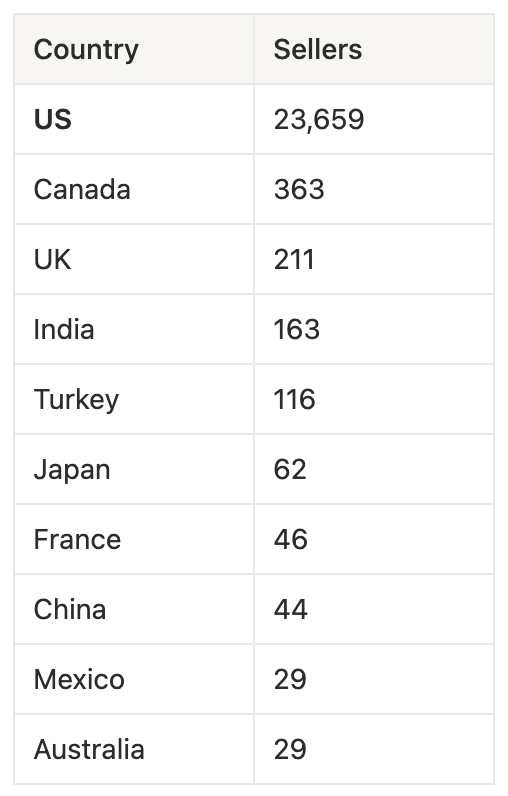
When you assemble all this data, you get a crystal-clear picture of who’s out there and how they’re operating. Curious how you stack up? Keep reading. Where Are They?The overwhelming majority of sellers are in the United States, but there’s a surprising international presence, with 6% of the sellers residing outside the States. Here are the top countries represented:
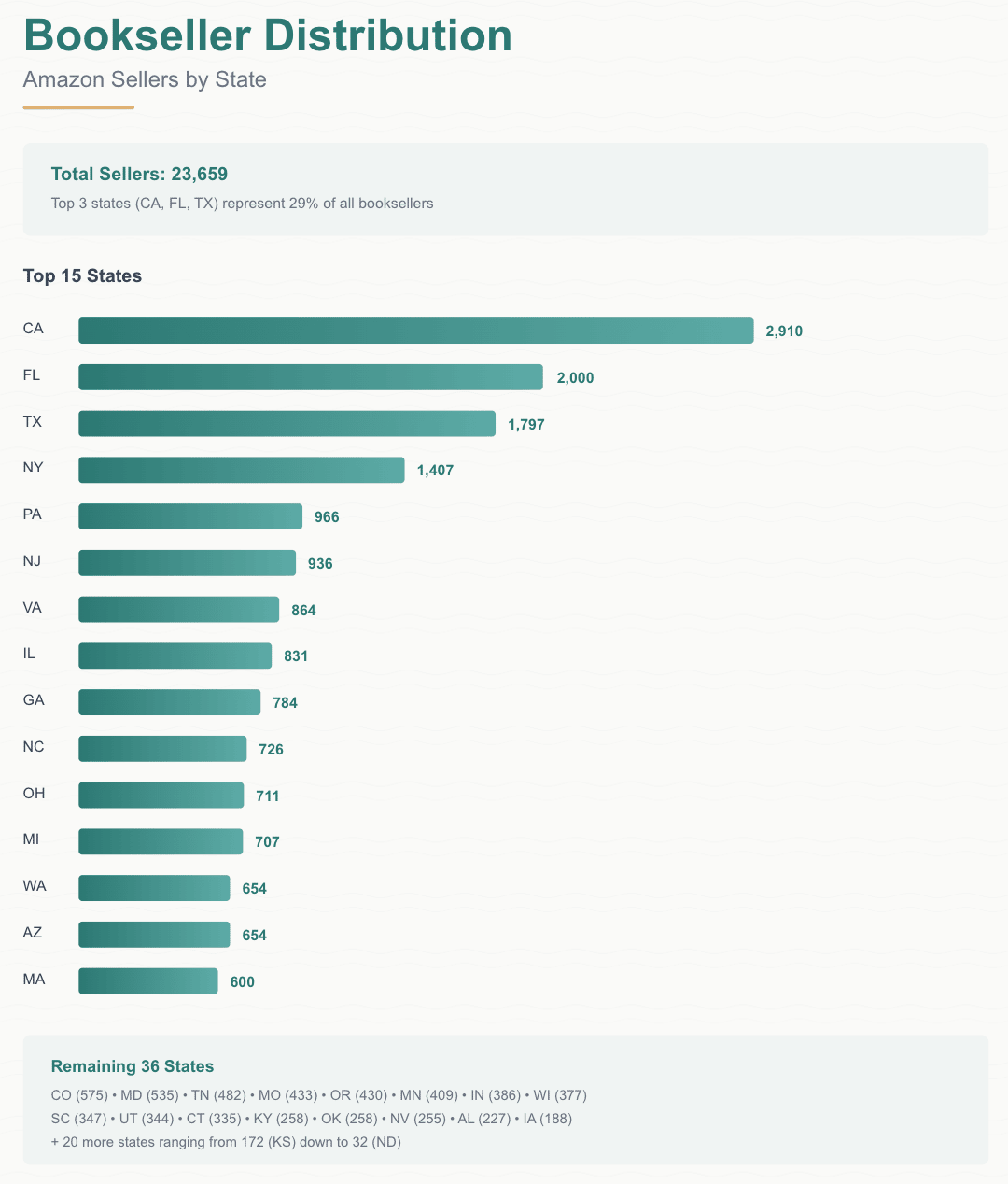
Within the US, the geographic distribution ranges from nearly 3,000 sellers in California to just 32 in North Dakota.
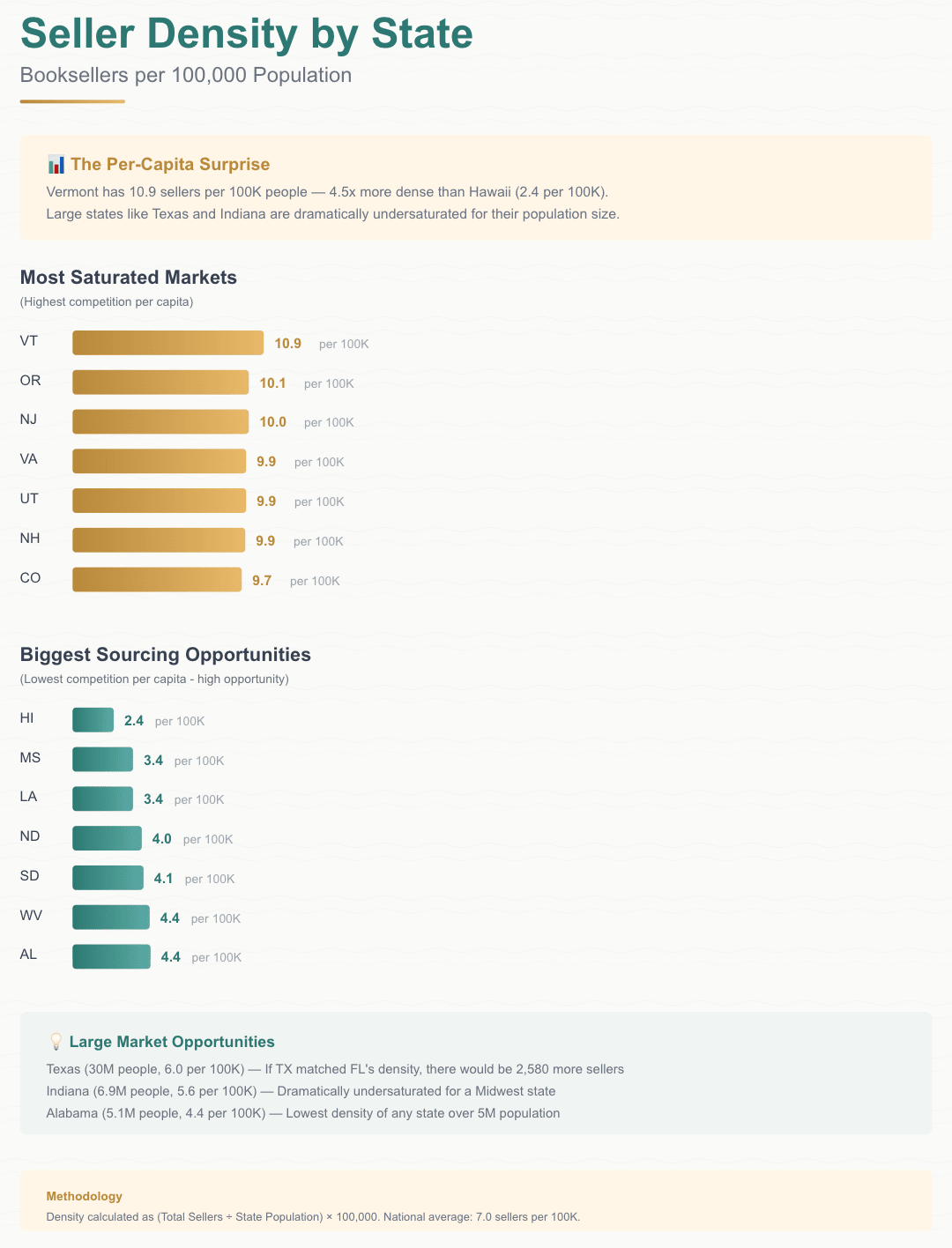
This data isn’t very useful, though, since the chart shown above closely resembles the most populous states. Naturally, that leads us to instead turn our attention to… Seller DensityWith 340 million Americans and 23,659 US-based booksellers, we’re looking at 7 booksellers per 100,000 people nationwide. To put that in perspective, if you’re lucky enough to attend a college football game at the University of Michigan or THE Ohio State University and look around the packed stadium, there’s likely to be six or seven (my kids are gonna have a field day with this) other booksellers in attendance. Bonus points if you can track them down in the crowd! Here’s the breakdown:
Fun fact: The first pass at this analysis showed Wyoming and Delaware as the highest-density states, which didn’t quite pass the sniff test. Turns out, 50 sellers were using the exact same Wyoming address - a classic LLC privacy move. After removing those duplicates, the real picture emerged. Units Sold: Cracking the CodeKeepa doesn’t give us sales data directly, but they do provide seller’s feedback rating counts - and we can reverse-engineer from there. On average, it takes about 150 orders to generate one customer rating. Some sellers see ratios as low as 50 or as high as 250, but most fall in the 125-175 range. So we’re using 150 as our multiplier for the sake of simplicity. So if a seller has 30 ratings in the past year, we estimate they sold roughly 4,500 units (30 × 150). Filtering the PoolFrom our original 25,142 sellers, we’re now focusing on those with at least one rating in the past year - proof they’re actually active. That eliminated:
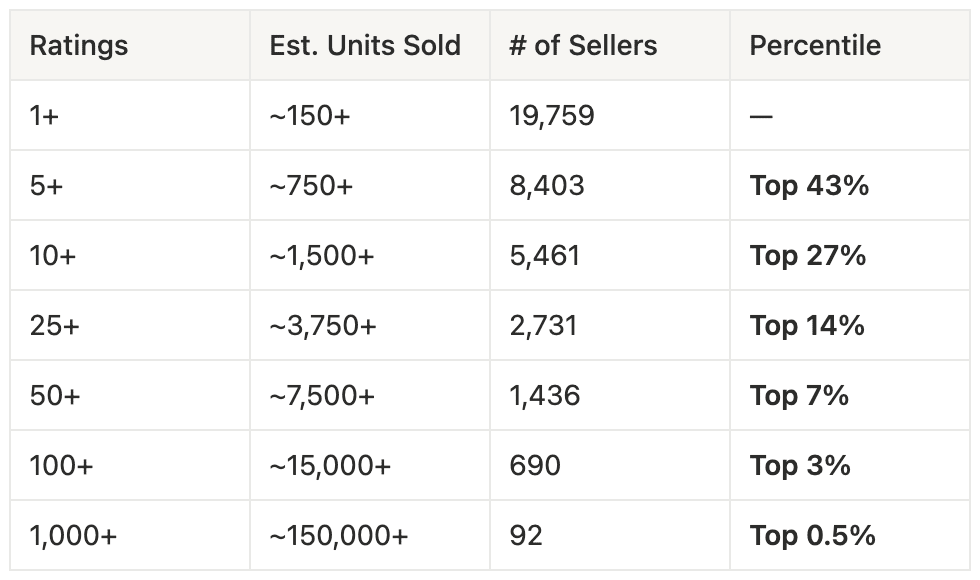
This leaves us with 19,759 active booksellers for the calculations below:
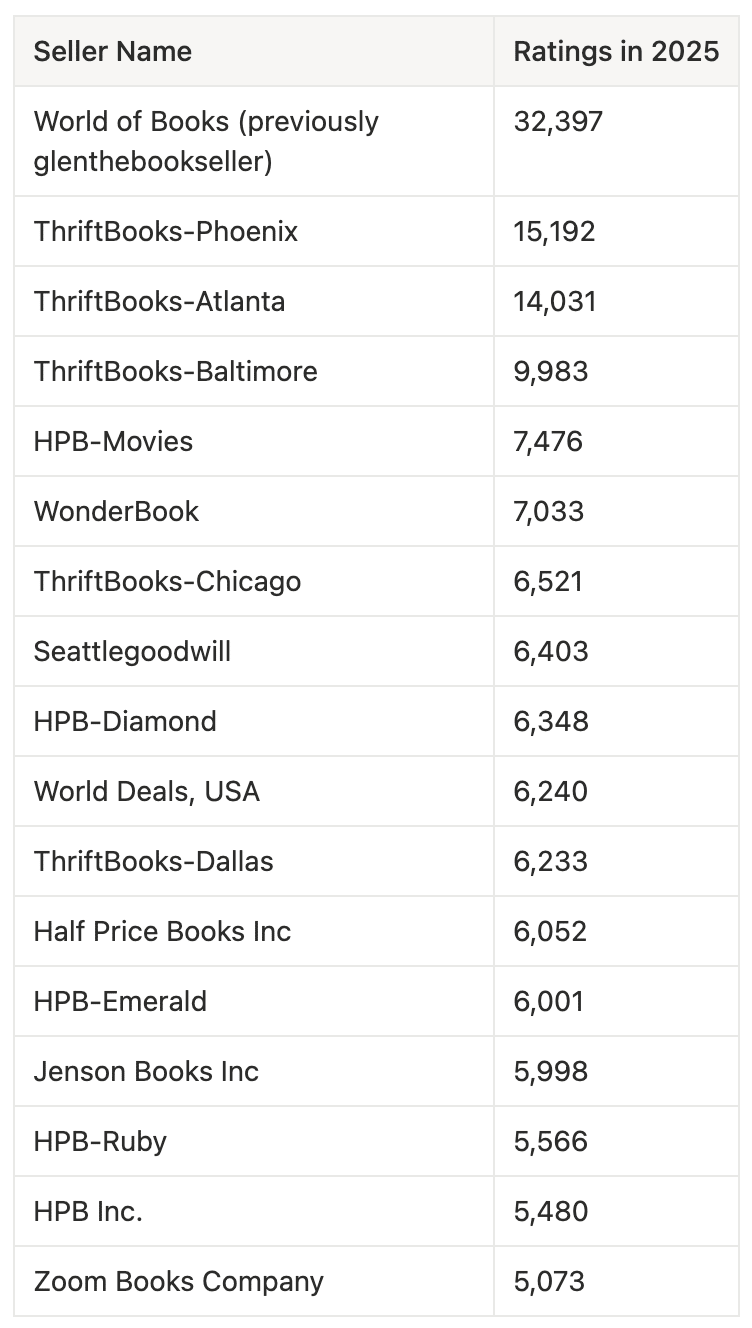
To see how you stack up, pull up your AmazonSeller App and on the home page it'll show you your Seller Feedback for the past year. The industry average is 32 ratings, but that’s heavily skewed by megasellers with thousands of ratings. The median seller has just 4 ratings. That means if you sold more than ~600 books last year, you’re in the top half of all US booksellers. Not bad, eh? Here’s a list of all the elite booksellers on Amazon with more than 5,000 ratings in the past year. You’ll probably recognize most of the names below:
To rack up 5,000+ ratings, you need to sell around 750,000 books annually. Only 17 sellers hit this milestone in 2025. At the top of the stack lies our friends over at World of Books (previously glenthebookseller of SellBackYourBook.com fame) with a jaw-dropping 32,000 reviews, which implies somewhere around 5 million books sold on Amazon alone. That’s some serious volume from the crew over in Illinois! (Astute observers will notice that if you combine all of the ThriftBooks accounts, their total rating count is higher than WOB. We’ll do these calculations in a future report.) Total Market VolumeThere are 638,593 total ratings tallied up by all booksellers last year. At 150 orders per rating, this implies 96M units were sold in 2025. (Keep in mind that our list of sellers doesn’t exclusively sell JUST books, so let’s call this a “directionally accurate” figure for estimating the volume of books sold by third parties on Amazon.) For the month of December alone, there were 46,191 total ratings, or an implied unit volume of 6.9M books sold on Amazon. The Long Tail of SellersYou’ve heard of the 80/20 rule? In bookselling, it’s even more extreme:
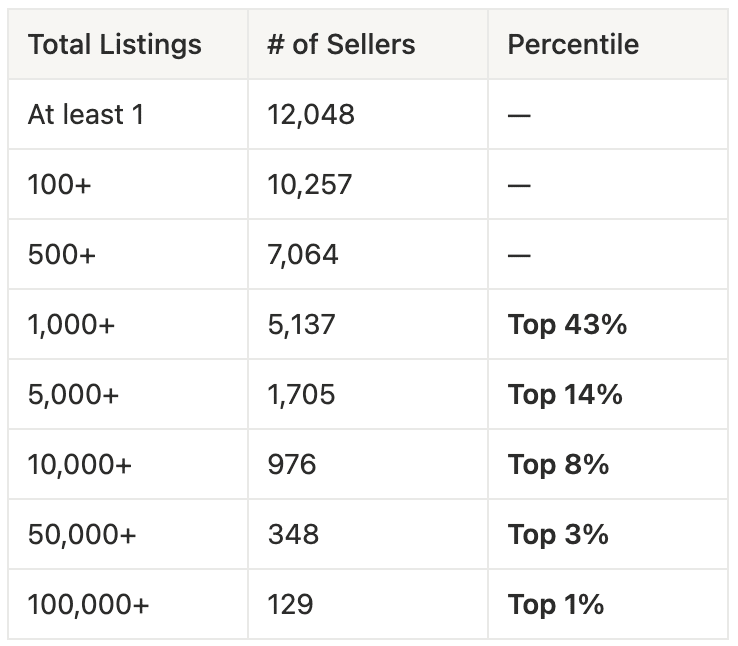
The megasellers dominate the market in terms of concentration of sales! Inventory LevelsMoving on from ratings, let’s look at the Keepa data for Total Listings to see how YOUR inventory levels stack up. (Note: This data assumes one offer per listing, so actual units in stock will be higher than shown below.)
This puts the average seller at around 8,000 listings. And with all the mom and pop operations out there, half of all booksellers have fewer than 800 listings to their name. FBA vs. MF: The Great DivideHere’s where things get interesting—and where we’ll be watching closely as the Used Buy Box changes play out. As of January 1, 2026:
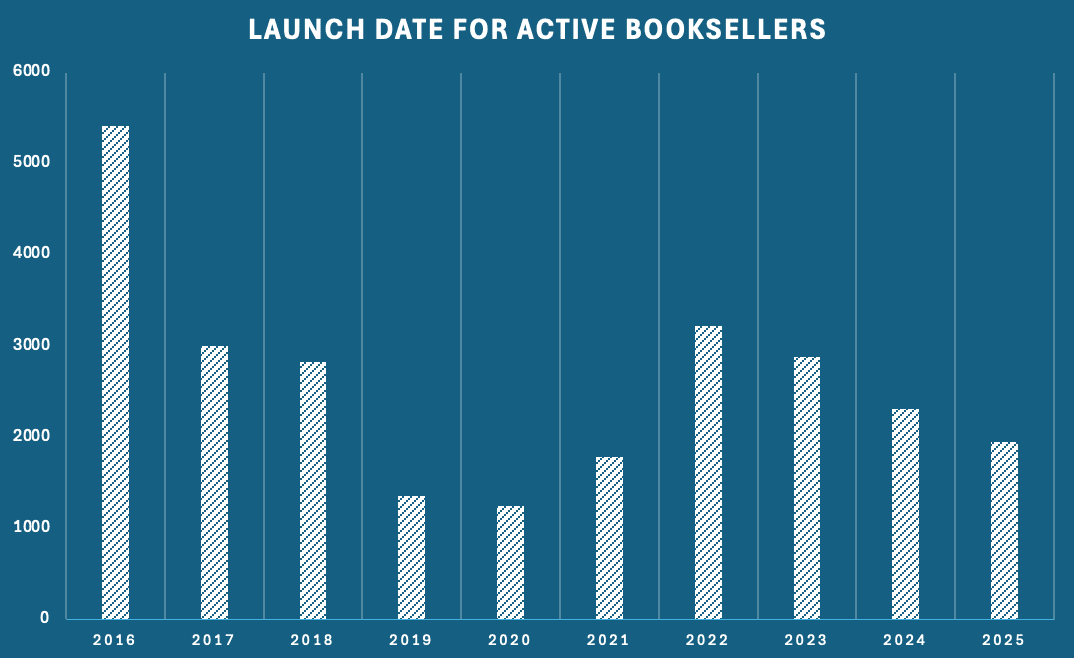
Interestingly, that 13% ratio holds even among megasellers with 50,000+ listings. Once you hit scale, Merchant Fulfillment becomes the dominant model. But roughly 1 in 8 sellers still use FBA in at least some capacity. Seller Longevity: When Did They Start?One of the data points Keepa returns is how long they’ve been tracking a seller. This provides insights into how long the typical seller has been flipping books on Amazon. (Note: Some megasellers like ThriftBooks show up as 2017 even though they’ve been around since the early 2000s - so treat pre-2017 as “legacy sellers.”) Keepa's data only goes back as far as 2016, which explains the spike on the left side of this chart.
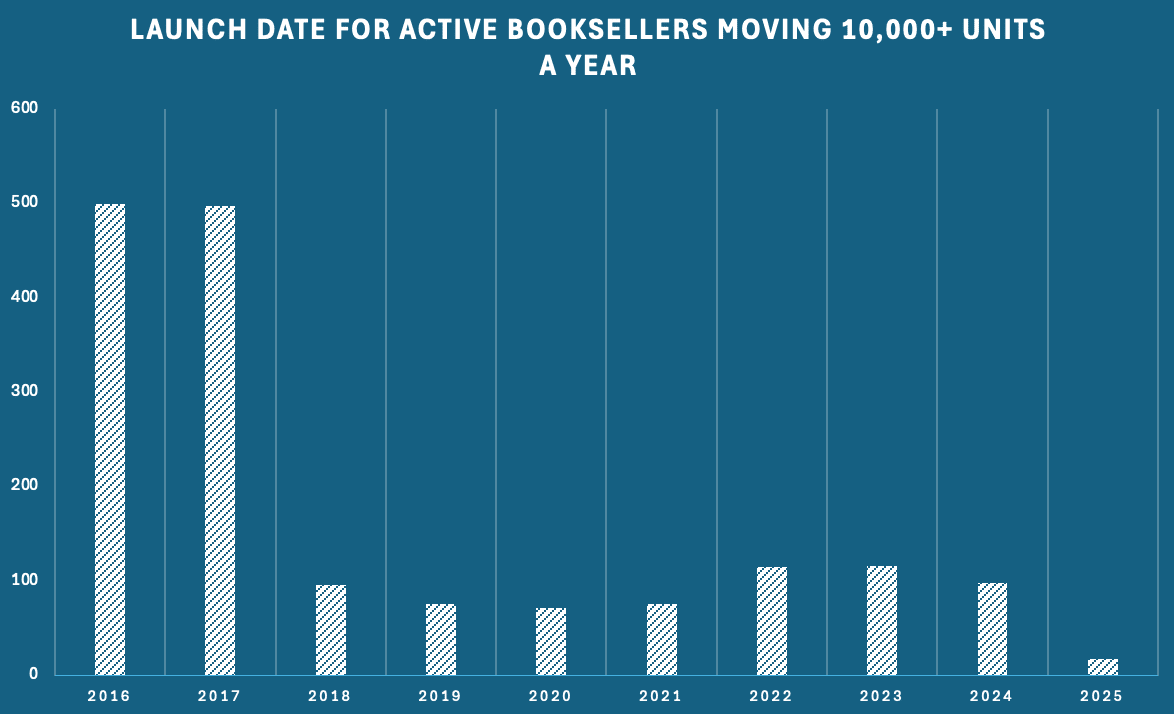
Nearly 50% of today's booksellers have been in business for longer than six years, while 8% of the sellers have been in business less than a year. What about larger sellers though? Surely those have all been established years ago and there’s no room at the top for new titans? Looking at sellers who moved 10,000+ units in 2025, here’s when they launched:
What’s Next?If you made it this far, pat yourself on the back. That was a lot of facts and figures! This Q1 2026 report is our starting line. As the Used Buy Box changes ripple through the market, we’ll be watching:
The next edition will compare back to this baseline and explore other media categories beyond books. In the meantime? Know your numbers. Find your edge. And keep flipping. Upstream Intel is researched and written by Caleb Roth, a 15+ year veteran of the bookselling space and founder of ScoutIQ, eFLIP, and thebookflipper.com. For inquiries or coaching, email caleb@upstreampursuits.com |
Comments
Loading comments…
Comments are reviewed before they appear. Your email is never shown.