 Upstream Pursuits
Thinking in Bets for Booksellers
Every book on your shelf has a type. Here's how to read the odds.
Let's face it: we're all gamblers.
Every book you list is a bet on its future. Don't believe me? Read on!
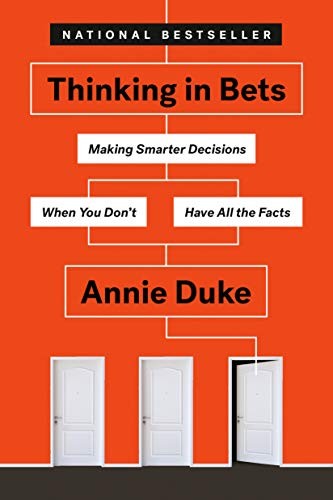
The title is borrowed from Annie Duke's Thinking in Bets, a book that changed how I look at the world. Annie spent years as a professional poker player, and her big idea is simple: every decision is a bet made without all the facts. A good decision can still lose a hand, and a bad one can still win. What matters is making good bets, over and over. Bookselling works exactly the same way. If you haven't read it, grab a copy on Amazon.
There are no guarantees in this business. You can scan a book with a great rank, price it right, ship it in, and still be holding it a year later. Every book you add to your inventory carries risk. So the useful question isn't will this book sell? It's what are the odds, and what does it pay when it does?
Those two answers sort every book into one of five types. We'll get to that in a second, but if you know the type, you can predict what a stack of books is worth the day you list it. We'll prove it to you!
Part one: how often does it sell?
A book's sales velocity is the biggest driver of whether your copy sells. We measure it in sale-days: the days in the past year when the book sold at least once.
Across our sellers, books that sell daily sold within six months 80% of the time.
Weekly sellers, 67%.
Monthly sellers, 52%.
And so on.
Surprisingly, a book that sells a copy every week leaves about 1 in 3 copies on the shelf after six months for the average bookseller (wondering how you compare? See State of the Book Market). That "sure thing" you held in your hand at the thrift store? Its risk profile may impact your bottom line more than you thought.
Remember - we're thinking in terms of probabilities, not promises.
Part two: what does it typically sell for?
Price, just like sales rank, can be extremely volatile. Today's listing price is just somebody's hope. What matters is what buyers actually paid.
This is where Keepa comes in. We can look back at the past few months (or years, if needed) of each title to see what the market typically paid for a book. Every time the sales rank drops, we look at the Used Buy Box or the cheapest used copy in Good or better condition (which typically ends up being the same thing). We aim to be conservative in our values here, so you can have confidence in these numbers as you make decisions on what to add to your inventory.
As a general rule, if the book sells often we only go back a few months in its history so you know that the values are likely to hold up in today's climate. If the book is thinly traded, we go back farther in its sales history to gather enough data to be statistically relevant.
Once we capture all the sold market prices, we line up those prices and throw out the top 20% and the bottom 20%, and keep the middle. That's the book's typical range: a low end, a typical price, and a high end.
Why toss the ends? The $90 sale to a desperate student happens. So does the $3 fire sale on a repricer gone wild. You can't plan on either one. You don't build a business on outliers. You build it on averages.
Here's what that looks like for two real books. Every dot is one sale from the past year:
The Art of Mexican Cooking sold 153 times. The median sale was $21.00: half of all sales were lower, and half were higher. The low end is $18.11, where only 20% of sales were lower. The high end is $25.00, where only 20% were higher. In Ranger, this book reads $18 · $21 · $25: low end, median, high end.
How about one more title, to help hammer home this concept:
Botticelli's Secret sold 49 times. Its median was $10.50, and its typical range ran from $7.61 to $13.82. A few copies went for $17 or more, but most buyers paid between $8 and $14. In Ranger: $8 · $10.50 · $14.
Could you squeeze a few more dollars out of some books? Absolutely. Price sharp, ship FBA, wait for the right buyer, and some of your copies will land in that top 20%. But you can't plan on it every single time. We build a business on averages, not exceptions.
It's not what you make, it's what you keep
Across every seller in our data, the average book sold for $22.14. But sales don't pay the bills. After Amazon took its fees and the shipping was paid, the average sold book left $13.49: about 61 cents of every dollar.
That's called payout: the sale price, minus Amazon's referral and closing fees, minus fulfillment (the FBA fee, or postage if you ship it yourself). We leave out what you paid for the book, inbound shipping, storage and removals, because those vary from seller to seller. Payout puts every book on the same scale.
Market payout tiers
Do that math on a book's median sale and you get its market payout: what a typical sale of that book leaves in your pocket. Ranger puts every book on the same fixed ladder of payout tiers: $0 or less, up to $1, $1 to $2.50, $2.50 to $5, $5 to $10, $10 to $25, $25 to $50, and $50 and up. The rungs never move, so any two books compare at a glance.
Here's how our sellers' books spread across the ladder:
Let's also look at the sell-through rates for each of these tiers, and the average payout per book listed:
| Market payout tier | Sold in 6 months | Payout per book listed |
|---|---|---|
| $0 or less | 39% | $1.84 |
| Up to $1 | 48% | $2.24 |
| $1 to $2.50 | 58% | $2.49 |
| $2.50 to $5 | 65% | $3.24 |
| $5 to $10 | 64% | $4.77 |
| $10 to $25 | 62% | $8.47 |
| $25 to $50 | 60% | $17.77 |
| $50+ | 54% | $36.92 |
Sell-through barely moves from tier to tier: from $1 up, about 6 in 10 books sold within six months. What changes is what each sale is worth. Below $2.50, a book can sell all day and still barely pay. So $2.50 is where we draw the line between books that pay and books that don't.
The five types
Put these two questions on a grid, and your complicated inventory business suddenly snaps into focus.
Across: does it sell fast (12 or more sale-days a year, about once a month)?
Up: does it pay well at its typical market payout ($2.50 or more)?
Every book with enough history lands in one of four squares. The books at the edge, with too few sales to place, are the fifth type - called Outliers.
- Engines sell fast and typically pay well. These should be the heart of your business.
- Vaults sell slowly but pay well. Patience gets rewarded here.
- Treadmills sell fast but pay very little. They feel productive but you're typically running in place and not getting anywhere.
- Doorstops sell slowly and pay almost nothing. Sure, you can catch a flier here or there but as a general rule, avoid these.
- Outliers live at the edge: fewer than 3 sale-days in the past year. The data gets fuzzy out here. Some are lottery tickets; some never sell. Telling them apart gets its own post soon.
Where the money comes from
Follow every book our sellers listed, from the left, to the money it brought back within six months, on the right:
Engines are a little over half the books and nearly three quarters of the money. Treadmills are one book in five and bring back a mere 6% of the bottom line. Same tape, same boxes, same trips to the post office.
Curious how your shelf splits? The Current draws this exact chart from your own Amazon sales.
Three types pay. Two don't.
Here's what 373,993 books from 53 sellers brought back within six months of listing:
| Type | Share of books | Sold in 6 months | Payout per book listed |
|---|---|---|---|
| Engine | 56% | 71% | $9.59 |
| Vault | 13% | 41% | $8.09 |
| Outlier | 8% | 18% | $5.33 |
| Doorstop | 4% | 32% | $2.61 |
| Treadmill | 20% | 56% | $2.24 |
Payout per book listed counts every book you put to work, including the ones that never sold. It's the honest number. Engines, Vaults and Outliers bring back $5 to $10 for every book you list. Treadmills and Doorstops bring back about $2, before you've paid a dime for the book.
Keep in mind these figures don't factor in any of the following:
- What you paid for a book.
- Your time to prep and list the books.
- Any of the FBA-specific fees, including inbound shipping, inventory placement fees, storage costs, and liquidations/removals/disposals.
Once you factor in those additional fees, your profit per book listed could very well be underwater for the Doorstops and Treadmills.
Want to see how those costs stack up, step by step? Read The True Cost of FBA in 2026. And to see your own numbers, with every one of those costs measured book by book, check out The Current. It's free for now.
How many books does it take to earn $1,000 in payouts?
Based on the typical payout numbers per book listed across all booksellers in our study, we can estimate how many books you'd have to list of each type to earn a payout from your Amazon Machine of $1,000.
About 104 Engines earn $1,000 in payout. So do 446 Treadmills: same tape, same boxes, four times the trips to the scanner.
Now add what you paid for the books. That comes out of every book you list, whether you sold them or not:
| Books to clear $1,000 after your buy cost | Bought at $1 | Bought at $2 | Bought at $3 |
|---|---|---|---|
| Engine | 117 | 132 | 152 |
| Vault | 142 | 165 | 197 |
| Outlier | 231 | 301 | 430 |
| Doorstop | 622 | 1,640 | Never |
| Treadmill | 807 | 4,167 | Never |
At $3 a book, every Treadmill and Doorstop you list loses money, so no stack is ever tall enough. The Engine stack barely notices. That's efficiency: not how many books you touch, but what each one brings home.
Using it to predict the future
Put the two parts together and you get a book's expected value:
Expected value = typical payout × odds it sells in six months
A weekly seller that typically pays $12:
$12 × 67% = $8.04 per copy you list.
Add it up across a box, and you know what this month's work is worth before a single copy sells.
It's simple, and it works. For Engines, Vaults and Outliers, that math landed within 5% of what the books actually paid.
Treadmills and Doorstops beat it, and they land near the high end of their typical sales ranges. Two reasons account for this: Most sellers set a price floor, so they don't let a cheap book go for pennies: about half of Treadmill sales and three in four Doorstop sales landed above the top of the typical market range. And about 8 in 10 of these books were shipped FBA, which still gets a small Prime bump (more on how FBA and the Buy Box changed in Unlocking the Secrets of the Buy Box). So we value these two types at the high end of their range. Even then, they pay a quarter of what an Engine does, and their sell-through rates are lower as a result of the price floors.
See your own shelf
What does your mix look like? How many of your books are Engines, and how many are Treadmills? The Current connects to your Amazon account and shows how your own business has fared over the past 18 months: every book you listed, its type, and what it actually paid you. It's free (for now!).
Sign up for The Current, free →
If you enjoyed this, drop a comment or question below. I read every single one. And if a bookselling friend could use it, send it their way.
Much love,
-Caleb
Comments
Loading comments…
Comments are reviewed before they appear. Your email is never shown.